
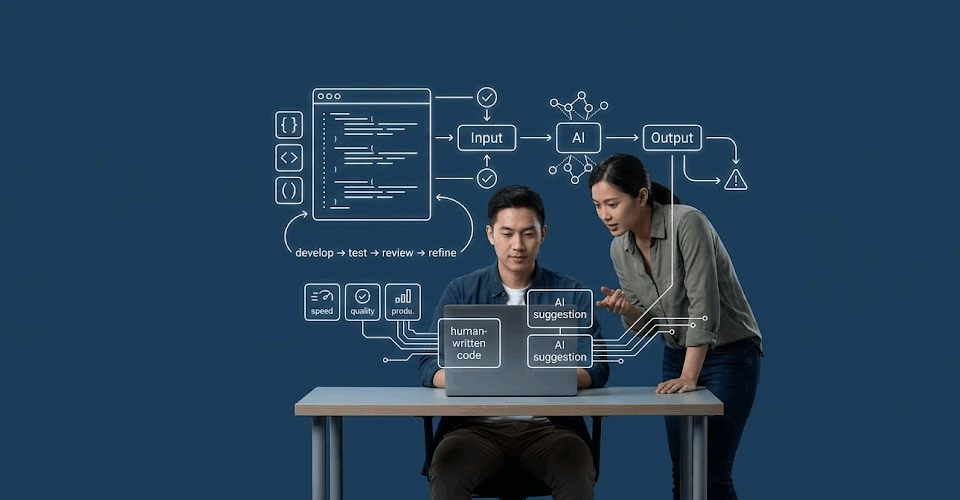
AI in Software Development
AI and Generative AI (GenAI) represent a paradigm shift in software development, moving the field from a predominantly manual, technical craft to a collaborative, higher-level orchestrational discipline1. They unlock a massive economic potential2, enable significant productivity gains3, and enhance the entire software development lifecycle1.
Get Involved
Do you want to know more about our research project? Contact us
Faster completion
Developers completed tasks with GitHub Copilot 55.8% faster than those without it
Improving code quality
Code quality improves by 89.7% on average when developers use AI tools

AI Transforms the Entire Software Development Lifecycle — Not just Coding
Generative AI is transforming every phase of the software development lifecycle, extending far beyond coding to reshape analysis, design, testing, operations, and maintenance.
Analysis and Requirements Engineering: AI tools help classify functional and non-functional requirements, detect contradictions and ambiguities in specifications, and increasingly enable end-to-end translation from natural language or multimodal inputs into system-level requirements1,6.
Software Design and Architecture: GenAI accelerates UI/UX prototyping, supports the creation of formal models (such as UML), evaluates architectural trade-offs, and flags design anti-patterns early in the process1.
Integration and Testing: AI generates comprehensive test suites and synthetic data, discovers edge cases that might otherwise be missed, and supports “shift-left” practices so that quality checks happen earlier and avoid integration bottlenecks1,6.
Operations and Maintenance: AI supports incident detection, root cause analysis, log monitoring, and automated remediation. It also helps predict system failures, optimize performance, generate documentation, and assist with long-term maintenance tasks such as code refactoring and technical debt management1,5.
Our Research Focus:
Qualitative Organizational Challenges
While quantitative productivity metrics grab headlines, our research shifts focus to the qualitative organizational challenges emerging as AI becomes embedded in software development teams.
Human-AI Collaboration and Developer Experience
Current research reframes development as “copiloting,” positioning AI as a partner rather than a replacement. This shifts developers’ core work from manual coding to strategic steering, output review, integration decisions, and maintaining creative oversight, which fundamentally changes daily workflows and team dynamics.
Evolving Skills, Roles, and Learning
AI adoption demands new competencies beyond traditional programming: sophisticated prompt engineering, critical evaluation of AI-generated outputs, and socio-technical understanding of tool limitations and team integration. Organizations must redefine developer roles, from pure “code producers” to “system orchestrators”, while rethinking onboarding, continuous learning, and career progression pathways.
Technical Limitations and Organizational Risks
AI tools struggle with context-heavy scenarios such as large legacy codebases, complex system architectures, and languages with sparse training data, leading to uneven adoption patterns. Longer-term risks include knowledge decay from over-reliance on AI for routine problem-solving, reduced deep technical reasoning, and potential skill atrophy across development teams.
Project Team

Juliane Möllmann
Postdoctoral Researcher
Department of Industrial Engineering and Management (TUTA)
Aalto University
1Ndiaye, A., Taraj, X., Robeznik, B., Herzog, G., Gerber, C., & Purwins, H. (2025). Generative AI in Software Engineering: Transforming the Software Development Process. Link
2Chui, M., Hazan, E., Roberts, R., Singla, A., Smaje, K., Sukharevsky, A., Yee, L., & Zemmel, R. (2023). The economic potential of generative AI – The next productivity frontier.
3Stanford AI Coding Productivity Study, Link
4Peng, S., Kalliamvakou, E., Cihon, P., & Demirer, M. (2023). The Impact of AI on Developer Productivity: Evidence from GitHub Copilot. Link
5Siili. (2024). GenAI Tests: Productivity Statistics & Analysis. Link
6Doddapaneni, P., Radzevych, B., Breeden, S., Bansal, B., & Rao, T. (2025). From Pilots to Payoff: Generative AI in Software Development. Link