
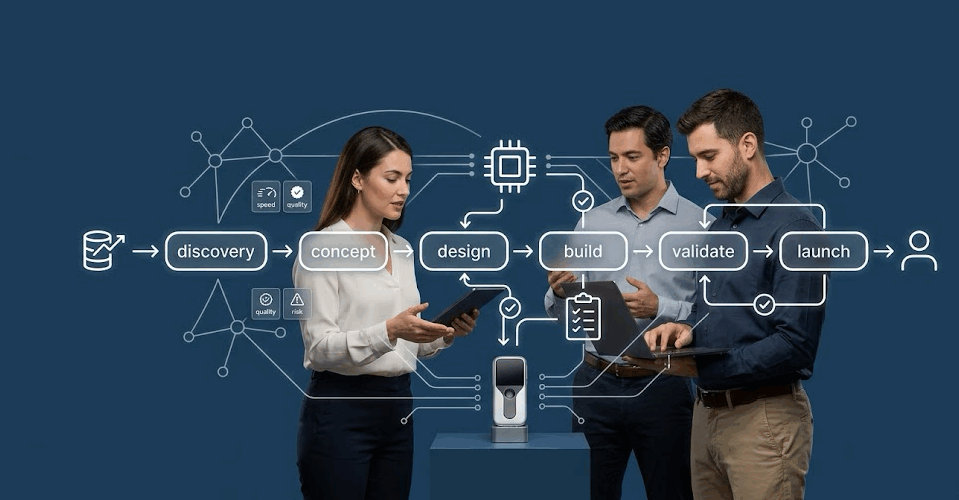
AI in New Product Development
AI and generative AI (GenAI) are changing how products are conceived, designed, and brought to market. It affects not only individual tasks such as ideation or prototyping, but also the structure and speed of entire development processes.
Generative AI enables rapid exploration of design alternatives, supports data-driven decision-making, and reduces the cost and time required to iterate. As a result, it has the potential to shift product development from sequential and resource-intensive processes toward more continuous, adaptive, and experiment-driven models.
Get Involved
We invite organizations, leaders, and practitioners interested in AI‑augmented work to collaborate with us for discussions, case studies, workshops, or joint events.
Acceleration of development cycles
Studies indicate that AI can reduce product development time significantly by automating design iterations and enabling faster testing. Reports by McKinsey & Company estimate that generative AI can accelerate certain innovation activities by 20–50%.
Increased productivity in knowledge work
Research from Boston Consulting Group shows that professionals using generative AI tools can complete complex tasks up to 25% faster while improving output quality.
Expansion of solution spaces
AI-driven design tools enable teams to autonomously explore and evaluate a vast array of alternatives, significantly increasing the likelihood of discovering novel, high-performing product concepts. Reports from Accenture emphasize that generative AI expands the “solution space” by utilizing agentic systems to identify breakthroughs that exceed human cognitive limits during early-stage R&D.
How AI transforms New Product Development
AI affects multiple dimensions of product development processes:
Faster and more iterative experimentation: AI enables rapid prototyping and simulation, reducing the cost of failure and increasing the number of iterations possible within a given timeframe. This shift enables companies to move from traditional, slow-cycle testing to “compressed transformation,” in which AI-driven simulations replace physical trials4.
Shift from intuition-driven to data-augmented decisions: AI supports decision-making by integrating large volumes of data, improving prioritization and evaluation of product concepts. Consulting reports note that AI-driven analytics provide leaders with predictive insights that move decision-making beyond human intuition toward high-probability success models5.
Integration of previously fragmented activities: AI systems connect design, engineering, and market insights, reducing coordination gaps across functions. Gartner highlights that AI acts as a connective tissue within the “digital thread,” ensuring that technical constraints and consumer demands are aligned in real-time6.
Continuous rather than stage-gated development: Generative AI supports ongoing adaptation, weakening rigid phase-based models and enabling more fluid development processes. Reports identify that traditional “stage-gate” hurdles are being replaced by continuous feedback loops, allowing for a more agile evolution of product features3.
Standardization and scalability of high-quality outputs: AI can codify best practices and ensure consistent execution across teams and projects. PwC emphasizes that by embedding organizational standards into AI workflows, companies can scale high-quality innovation across global teams without a loss in precision5.
Our Research Focus
Process-Level Transformation in Product Development
Rather than examining isolated use cases, this research focuses on how AI alters the underlying structure of new product development. The emphasis is on processes, not tools: how activities are organised, how decisions are made, and how work is coordinated across teams.
AI in Development Work and Experimentation
AI is increasingly embedded in core development activities such as ideation, prototyping, and testing. This changes how quickly teams can iterate, how alternatives are generated, and how learning occurs throughout the development cycle. The research examines how these shifts affect both efficiency and the nature of experimentation.
AI-Augmented Decision-Making
AI introduces new forms of input into product decisions, from data-driven recommendations to generated design options. This raises questions about how decisions are evaluated, how responsibility is assigned, and how judgment is exercised when human and AI contributions intersect.
Redesign of Product Development Processes
Existing development processes are typically not designed for AI integration. The research investigates how workflows, handoffs, and coordination mechanisms must be restructured to accommodate AI, and how different process configurations influence outcomes.
Changing Roles, Collaboration, and Coordination
AI affects how work is distributed within and across teams. Roles shift, new responsibilities emerge, and collaboration patterns evolve as AI becomes part of everyday development work. The focus is on how these changes reshape cross-functional interaction and team dynamics.
Project Team

Natalia Vuori
Associate Professor
Department of Industrial Engineering and Management (TUTA)
Aalto University
Get Involved
We invite organizations, leaders, and practitioners interested in AI‑augmented work to collaborate with us for discussions, case studies, workshops, or joint events.
1 McKinsey & Company, The Economic Potential of Generative AI: The Next Productivity Frontier (2023) Link
2 Dell’Acqua, F., McFowland, E., Mollick, E. R., Lifshitz-Assaf, H., Kellogg, K., Rajendran, S., Krayer, L., Madani, F., & Lakhani, K. R. (2023). Navigating the jagged technological frontier: Field experimental evidence of the effects of artificial intelligence on knowledge worker productivity and quality. Harvard Business School Technology & Operations Mgt. Unit Working Paper. https://doi.org/10.2139/ssrn.4573321
3 Accenture, Technology Vision 2025: AI—A Declaration of Autonomy (2025) Link
4 Accenture, Making Reinvention Real with Generative AI (2024) Link
5 PwC, 2023 Global Emerging Technology Survey (2023) Link
6 Gartner, Top Strategic Technology Trends for 2024 (2024) Link