

AI and Worklife: Why Finland’s Real AI Challenge Is Organizational, Not Technical
AI is no longer a niche technology. Like electricity or the internet, it is becoming a general-purpose technology that reshapes products, processes, and entire industries. Global investment is accelerating rapidly, yet the central question for many countries is no longer whether AI matters, but whether their institutions, firms, and workforce can adapt fast enough. This presentation argues that Finland has strong potential in the AI era, but current adoption remains too slow to capture the opportunity.
One major shift is already visible in the labor market. Entry-level roles in areas such as administration, accounting, consulting, and software development are shrinking as AI takes over tasks once assigned to junior employees: drafting reports, summarising information, preparing slides, writing basic code, and conducting background research. At the same time, new high-skilled roles are emerging in AI governance, cybersecurity, change leadership, and human AI collaboration. The risk is not simply job loss, but polarization between workers, firms, and regions that adapt quickly and those that fall behind.
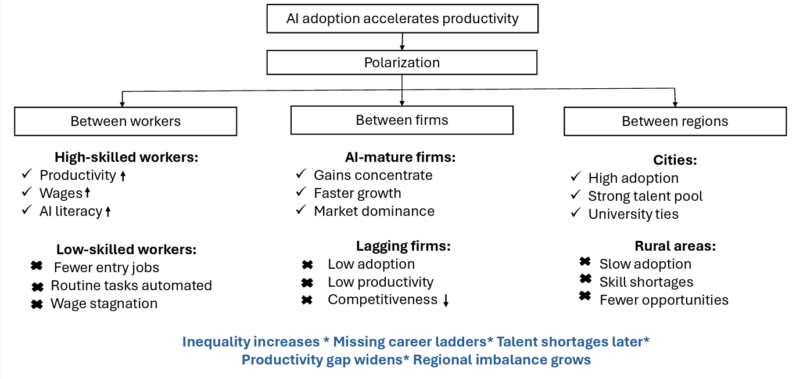
The discussion outlines several reasons for the limited adoption rates in Finland. Many organizations are stuck in pilots rather than embedding AI into core processes. Low AI maturity means employees often lack the practical capability to create value in daily work. Leaders may hesitate because of unclear ROI, short-term KPIs, or fear of making mistakes under regulation. In some cases, firms publicly signal AI ambition while privately waiting for others to prove the business case first. This creates collective inertia at exactly the moment when learning speed matters most.
The core differentiator, according to the presentation, is leadership. Successful organizations will not be defined by access to tools alone, but by leaders who build trust, reduce fear, create psychological safety, and redesign work around human AI collaboration. They must also decide how productivity gains and time savings are reinvested, whether into more output, better quality, innovation, learning, or employee well-being. Without that guidance, much of AI’s potential remains unused.

The conclusion is a strategic choice. Finland can drift toward shrinking career ladders, widening inequality, and lost competitiveness, or it can build empowered workers, strong public services, and a productive private sector. Doing so requires targeted training, long-term investment in capabilities and infrastructure, AI-ready leadership, and an education system that combines technical, ethical, and critical thinking skills across generations. The future of work will not be determined by AI alone, but by how societies choose to organize around it.